
TL;DR:
- Blended learning combines face-to-face and online education, with students controlling their schedule and pace. Its success depends on well-designed, integrated content and a shift in teacher roles from lectures to facilitation. Effective models match online and in-person activities to students' self-management skills and learning needs.
Blended learning is defined as the intentional combination of face-to-face classroom teaching and online learning, where students have meaningful control over the time, place, path, or pace of their education. Also called hybrid learning or mixed-mode learning, it is not simply a teacher uploading slides to a website. The approach requires three core elements: student control over learning, physical presence of both teacher and students at some point, and content that is genuinely integrated across both modalities. Common models include the Flipped Classroom, Rotation, Flex, and Enriched Virtual formats. Research consistently shows that well-designed blended programmes outperform traditional teaching in student engagement, satisfaction, and skill development.
What is blended learning and how does it work?
Blended learning works by splitting educational content and activities across two environments: online and in person. The online component might involve video lessons, interactive quizzes, discussion forums, or self-paced reading modules. The in-person component then uses that foundation for deeper discussion, hands-on practice, or targeted teacher support.

The key word is integration. Online and face-to-face activities must connect and reinforce each other. A student who watches a recorded lecture before class arrives ready to apply concepts rather than hear them for the first time. That shift changes everything about how class time is used.
Blended learning differs from fully online learning because physical attendance remains part of the design. It also differs from traditional classroom learning because online components are not optional extras. They carry equal weight in the learning experience. For a closer look at how online and classroom learning compare, the differences in structure and outcomes are worth understanding before choosing a format.
What are the main models of blended learning?
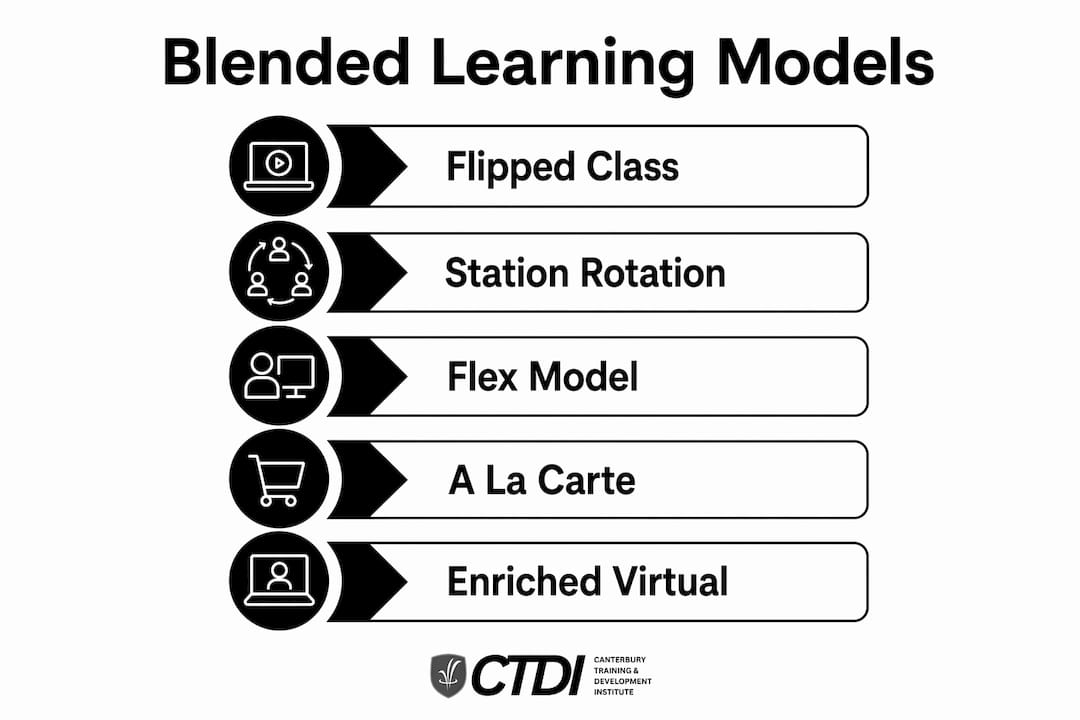
Several recognised models exist, each distributing online and in-person time differently. The right model depends on the subject, the student group, and the available technology.
Flipped classroom
The Flipped Classroom reverses the traditional sequence. Students consume new content online at home, then use class time for problem-solving, discussion, and teacher-guided practice. This model suits secondary and tertiary students who can manage independent study and benefit from active classroom sessions.
Rotation models
Rotation models divide students into groups that cycle through different learning stations. In the Station Rotation model, students rotate between an online station, a teacher-led station, and a collaborative activity station within the same classroom. The Lab Rotation model moves students to a separate computer lab for their online work. The Individual Rotation model gives each student a personalised schedule rather than a fixed group rotation. These models work well in primary and secondary settings where teachers want to maintain close oversight while differentiating instruction.
Flex, A La Carte, and Enriched Virtual
The Flex model delivers most content online, with teachers available in person for support as needed. Students move through material at their own pace. The A La Carte model lets students take individual online courses alongside their regular school programme, useful for subjects not offered at their school. The Enriched Virtual model is primarily online, with required face-to-face sessions scheduled periodically. This model suits older students and adult learners who need maximum flexibility.
| Model | Primary delivery | Student control | Typical use |
|---|---|---|---|
| Flipped classroom | Online pre-work, in-person application | Moderate | Secondary, tertiary |
| Station rotation | In-person with online station | Low to moderate | Primary, secondary |
| Flex | Mostly online, in-person support | High | Secondary, adult learners |
| A La Carte | Fully online single subject | High | Secondary supplementary |
| Enriched Virtual | Mostly online, periodic in-person | High | Tertiary, adult learners |
Pro Tip: Match the model to your students' self-management skills. High-autonomy models like Flex work best when students have already developed independent study habits. Rotation models suit younger learners who benefit from structured transitions.
What are the benefits of blended learning?
The evidence for blended learning is strong. Students report higher satisfaction, stronger motivation, and better academic outcomes in blended formats compared to traditional classroom-only teaching. That finding holds across multiple recent studies and education levels.
For students
- Flexibility: Students access content at any time, which suits different schedules and learning speeds.
- Self-paced progress: Learners can revisit recorded lessons or pause to take notes without disrupting others.
- Active participation: Class time shifts from passive listening to discussion, problem-solving, and collaboration.
- Digital skills: Regular use of online platforms builds the technical literacy employers now expect.
- Improved engagement: 24/7 access and self-paced learning increase engagement, particularly for students who struggle in traditional lecture formats.
For parents
- Visibility: Many blended platforms give parents access to progress dashboards, attendance records, and assessment results.
- Reduced commuting: Online components cut travel time, particularly for students in regional areas.
- Supported independence: Students develop self-management skills while still having structured teacher contact.
For educators
- Cost and time savings: Blended formats reduce venue costs, printing expenses, and the time spent on routine content delivery.
- Data-driven teaching: Platforms generate attendance and performance data that teachers use to identify students who need extra help.
- Smaller effective class sizes: When students rotate or work independently online, teachers can give more focused attention to smaller groups.
- Content updates: Updating a recorded module is faster and cheaper than reprinting textbooks or rewriting handouts.
The flexibility of online learning is one of the most cited reasons students and working adults choose blended programmes over traditional formats.
What challenges affect blended learning implementation?
Blended learning delivers results when it is designed well. Poor implementation produces the opposite effect. The most common mistake is posting slides online without changing classroom methods. That approach adds technology without changing pedagogy, and students gain none of the benefits.
Course design is the foundation
Online and in-person components must be designed as complementary parts, not separate streams. A blended course that treats its online content as optional reading and its classroom time as standard lectures is not blended learning. It is traditional teaching with a website attached.
Poor online navigation and unclear content harm student outcomes regardless of how good the in-person teaching is. Students who cannot find their materials, cannot tell which tasks are due, or encounter broken links disengage quickly. Platform usability is not a minor technical concern. It directly affects learning.
The teacher's role changes significantly
Teachers must shift from delivering lectures to facilitating learning. In a blended classroom, the teacher monitors progress data, identifies students falling behind, and uses in-person time for targeted interventions rather than whole-class instruction. That shift requires training and institutional support. Many educators find the transition demanding without both.
Increased workload is a real barrier, particularly during the design phase. Building quality online content, learning a new platform, and redesigning assessments takes time. Schools and training providers that invest in that upfront effort see better long-term results.
Pro Tip: Before launching a blended programme, pilot the online platform with a small group of students. Their feedback on navigation and clarity will save hours of troubleshooting once the full cohort is enrolled.
How to implement blended learning: practical steps
Successful blended learning does not happen by accident. Students, parents, and educators each play a role in making it work.
-
Start with clear learning goals. Decide what students need to know and do by the end of the course. Then assign each goal to either the online or in-person component based on which environment suits it best.
-
Choose a platform students can actually use. The technology must be accessible on the devices students own. A platform that works only on desktop computers fails students who study on phones or tablets.
-
Set a consistent weekly rhythm. Students manage blended learning better when the structure is predictable. For example: watch the module video by Wednesday, complete the quiz by Thursday, attend the workshop on Friday.
-
Use data to guide in-person time. Most learning management systems track quiz scores, time on task, and completion rates. Teachers use this data to identify which students need direct support before the next face-to-face session.
-
Build in social and collaborative activities. Students value the cognitive and social benefits of in-person interaction. Online autonomy works best when it is balanced with group work, discussion, and peer feedback during class time.
-
Support parents with clear communication. Send a brief guide explaining how the blended format works, where to find progress information, and who to contact with questions. Parents who understand the structure are better placed to support their children at home.
-
Review and adjust regularly. Collect student feedback at the midpoint of each term. Small adjustments to pacing, content clarity, or platform navigation make a measurable difference to completion rates.
The role of support services in e-learning is often underestimated. Students who know where to get help when they are stuck are far more likely to complete their courses.
Key takeaways
Blended learning succeeds when online and in-person components are designed as equal, integrated parts of a single learning experience, not as separate add-ons.
| Point | Details |
|---|---|
| Blended learning definition | It combines face-to-face and online learning with student control over pace, path, or place. |
| Multiple models exist | Flipped Classroom, Rotation, Flex, and Enriched Virtual each suit different student groups and subjects. |
| Evidence supports adoption | Students report higher satisfaction and engagement in blended formats than in traditional classroom-only teaching. |
| Design quality is critical | Poor online navigation and unchanged classroom methods undermine results regardless of technology used. |
| Teacher role must shift | Educators move from lecturing to facilitating, using data to target support during in-person time. |
Blended learning works best when we stop treating it as a compromise
My honest view is that most institutions still treat blended learning as a halfway measure. They keep the traditional lecture at the centre and bolt online content around the edges. That is not blended learning. It is traditional teaching with extra steps.
The programmes I have seen work well share one characteristic: the educators redesigned their courses from scratch with both environments in mind. They did not ask "how do we put this lecture online?" They asked "what does each environment do best, and how do we use both?" That question changes everything.
The social dimension of in-person learning is genuinely irreplaceable. Students who study entirely online often report feeling isolated, even when the content is excellent. Blended learning, done properly, gives students the flexibility they need without stripping away the human connection that keeps them motivated.
Teacher training is the piece most institutions underinvest in. A well-designed platform with an unprepared teacher produces worse outcomes than a mediocre platform with a skilled facilitator. The technology is the easy part. Changing how educators think about their role is the hard part, and it takes time, practice, and support.
The future of blended learning will involve more personalised data, better adaptive content, and tighter integration between online and in-person activities. But the core principle will not change. Learning is a human activity. The best blended programmes use technology to create more space for human interaction, not less.
— Sam
Flexible courses that put blended learning into practice
Edu, the Canterbury Training and Development Institute, offers nationally recognised diploma courses built for learners who need flexibility without sacrificing quality. Courses in AI, digital marketing, and environmental management are delivered online by industry experts, with structured support built into every programme.
Whether you are a student building career skills, a parent exploring options for further education, or an educator looking to upskill, Edu's courses are designed around the same principles that make blended learning effective: clear structure, expert guidance, and learning at a pace that suits your life. Enrol in a diploma course and take the next step with a provider that understands how modern learners study.
FAQ
What is the blended learning definition?
Blended learning is the intentional combination of face-to-face instruction and online learning, where students have control over the time, place, path, or pace of their education. Both components are integrated, not treated as separate streams.
How does blended learning differ from fully online learning?
Blended learning requires physical attendance at some point, whereas fully online learning has no in-person component. The face-to-face element in blended learning is a core part of the design, not an optional add-on.
What are the most common blended learning models?
The most widely used models are the Flipped Classroom, Station Rotation, Flex, A La Carte, and Enriched Virtual. Each distributes online and in-person time differently to suit different student groups and subjects.
What are the main benefits of blended learning for students?
Students report higher satisfaction and motivation in blended formats, along with greater flexibility, improved digital skills, and more active participation compared to traditional classroom-only teaching.
Is blended learning suitable for all ages?
Blended learning works across primary, secondary, and tertiary levels, but the right model varies by age. Younger students benefit from structured rotation models with close teacher oversight, while older and adult learners often thrive in high-autonomy formats like Flex or Enriched Virtual.