

A microcredential is a certification of assessed learning or competency, with a minimum learning volume of one hour and shorter than an Australian Qualifications Framework (AQF) award qualification. That is the official definition under Australia's National Microcredentials Framework, and it draws a clear line: the learning must be assessed, not just attended. You can think of it as a verified proof of a specific skill, delivered in a fraction of the time a traditional qualification takes.
Key features that define a microcredential:
- Assessed learning: Completion alone does not qualify. Assessment of competency is mandatory.
- Shorter than an AQF award qualification: Microcredentials sit below the formal qualification threshold, making them faster to complete.
- Targeted focus: Each one addresses a specific skill or knowledge area, not a broad field.
- Digital certification: Most result in a digital badge or verified certificate that can be shared with employers.
- Minimum learning volume: There is a minimum required learning volume established below the full AQF qualification level.
- Distinct from full degrees: They are additional, alternate, complementary to, or a component part of an AQF award, not a replacement for one.
How do microcredentials differ from traditional qualifications?
The most obvious difference is duration. A microcredential can be completed within a single academic cycle or less, whereas a diploma or degree typically spans one to several years. That compression is intentional: the goal is targeted skill acquisition, not a well-rounded curriculum.
Traditional qualifications are designed to give learners a broad, complementary set of knowledge across a field. Microcredentials do the opposite. They go deep on one topic and stop there. A cybersecurity professional does not need to re-enrol in a full IT degree to learn cloud security protocols; a single assessed microcredential covers the gap.
Other distinguishing characteristics:
- Credit-bearing or non-credit-bearing: Microcredentials can carry formal credit toward a larger qualification, or stand alone without contributing to one.
- Stackable: Multiple microcredentials can be combined progressively to build toward a larger formal qualification, giving learners a modular pathway rather than an all-or-nothing commitment.
- Designed for flexibility: Self-paced and online delivery is common, which suits working adults who cannot step away from employment.
- Lifelong learning focus: Unlike a degree taken once in early adulthood, microcredentials are designed to be revisited throughout a career as skills needs shift.
What are the real benefits for learners and employers?
For learners, the core benefit is speed to competency. When a job market shifts, waiting two years for a new degree is not practical. Microcredentials let you upskill and reskill in weeks rather than years, with a verified credential to show for it at the end.
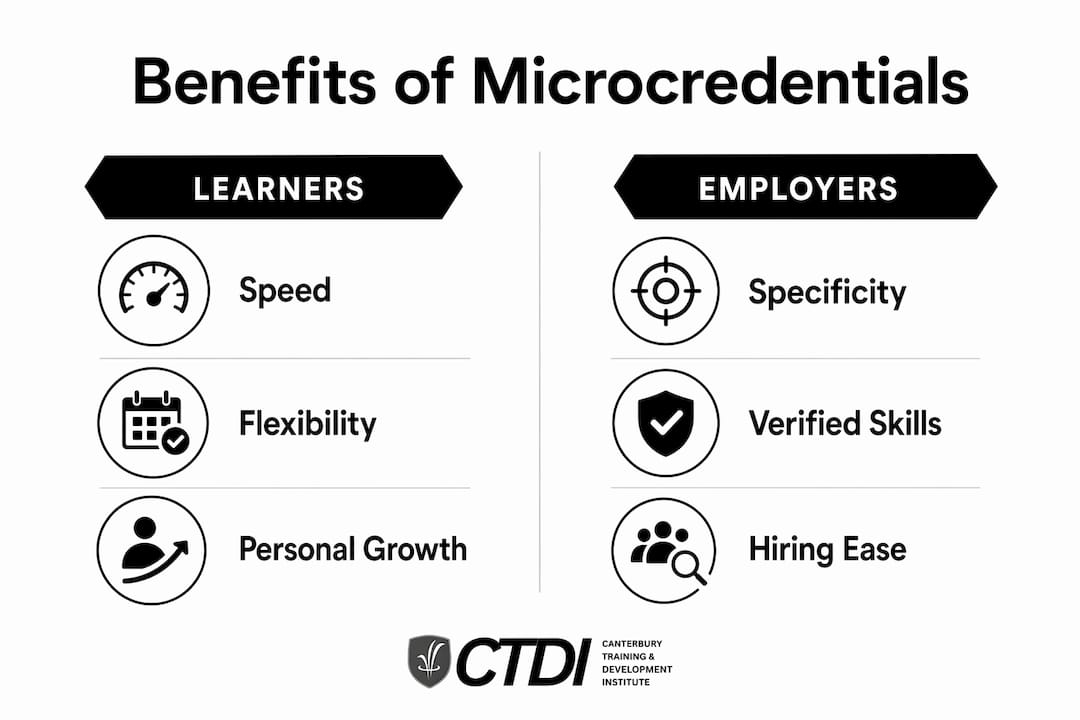
The OECD notes that learners pursue microcredentials not only for career advancement but also for personal interest and as accessible entry points into higher education. That last point matters for adult learners who left formal education early and want a low-risk way back in. A single assessed microcredential is far less daunting than re-enrolling in a full programme.
For employers, the value is specificity. A digital badge tied to an assessed microcredential tells a hiring manager exactly which competency a candidate has demonstrated, rather than leaving them to infer skills from a broad degree title. Employers can also sponsor targeted microcredentials for existing staff, which is cheaper and faster than funding a full qualification. Learners who want to explore career-focused courses will find microcredentials a direct path to demonstrable workplace skills.
How are microcredentials quality-assured in Australia?
Australia's National Microcredentials Framework is the governing standard. It sets out what qualifies as a microcredential, what information providers must disclose, and what minimum standards apply. Without alignment to this framework, a credential carries no national recognition guarantee.
Quality assurance frameworks are what separate a credible microcredential from a participation certificate. Assessment is non-negotiable: under the National Microcredentials Framework, unassessed learning and badges obtained through participation only do not qualify. This distinction protects both learners and employers from credentials that look official but carry no verified competency.
Industry collaboration is the other quality lever. Courses designed in partnership with employers and professional bodies reflect real workplace needs rather than academic assumptions about what the market wants. Portability matters too: microcredentials are learner-owned and portable, meaning you can share and verify them across employers and education providers without relying on a transcript from a single institution.
Pro Tip: Before enrolling, check whether the provider explicitly aligns their microcredentials with the National Microcredentials Framework. If the course page does not mention assessment outcomes or national recognition, ask directly.
Where can you access microcredentials in Australia?
Microcredentials are available through universities, TAFEs, registered training organisations (RTOs), and private vocational providers. Online delivery is the norm rather than the exception, which suits learners in regional areas or those balancing work and study. You can read more about how online learning supports flexible career growth and why it has become the default mode for professional development.

Practically, microcredentials come in two forms: standalone short courses that deliver a single credential, and assessed modules within a larger qualification that can be completed independently. The stackable model is worth understanding. You can complete one microcredential now, add another in six months, and eventually accumulate enough to count toward a formal diploma or degree, without ever committing to the full programme upfront.
When choosing a provider, verify three things: that the course includes formal assessment, that the credential is nationally recognised, and that the content was developed with industry-relevant training input. A microcredential from a provider that ticks all three carries genuine weight with employers.
What do microcredentials typically cost in Australia?
Costs vary considerably by provider, subject area, and course length. Microcredentials are generally far more affordable than a diploma or degree, which makes them accessible to learners who cannot commit to the financial outlay of a full qualification.
Some microcredentials are eligible for government subsidies or funding support, depending on the provider's registration status and the course category. Employers frequently sponsor microcredentials for staff as part of professional development budgets, particularly when the credential maps directly to a workplace skill gap. For learners funding their own study, the shorter duration means less time away from paid work, which reduces the real cost beyond the course fee itself.
The value question comes down to outcomes. A targeted microcredential in a high-demand area such as AI, data analysis, or digital marketing can open doors that a generic short course cannot, because the assessed credential gives employers something concrete to evaluate. Learners who support lifelong learning as a career strategy tend to treat microcredentials as investments with a clear return, not expenses.
How does Edu (CTDI) deliver microcredentials in Australia?
Canterbury Training and Development Institute (CTDI), operating as Edu, offers nationally recognised vocational microcredentials across areas including artificial intelligence, digital marketing, and sustainability. Courses are designed by industry experts and delivered entirely online in a self-paced format, which means you can complete them around existing work and life commitments.
Edu's microcredentials result in digital certification that learners can share directly with employers or add to professional profiles. The courses align with the National Microcredentials Framework standards, covering assessed learning outcomes rather than participation-only completion. For healthcare professionals and other specialists seeking targeted skill development, the model of targeted learning for nurses and similar professionals illustrates exactly why focused, assessed credentials outperform generic professional development courses.
Edu's vocational microcredentials are built around what industry actually needs, not what fits neatly into a traditional curriculum. Each course is assessed, nationally recognised, and designed to translate directly into workplace capability.
Pro Tip: If you are considering a microcredential for career advancement, look for providers whose courses are explicitly mapped to industry competency standards. Edu's course pages list the skills outcomes and industry alignment for each programme.
What are the limitations of microcredentials?
Microcredentials are not universally recognised. While the National Microcredentials Framework provides a national standard, uptake among employers is still uneven. Some hiring managers remain unfamiliar with how to evaluate a digital badge compared to a traditional qualification, particularly in sectors where formal degrees have long been the default signal of competency.
Stackability sounds straightforward in theory, but credit transfer between providers is not always guaranteed. A microcredential completed with one RTO may not automatically count toward a qualification at a different institution, so learners need to confirm credit arrangements before committing to a stacking pathway.
There is also a quality consistency problem. Not every provider calling their course a "microcredential" meets the assessed learning standard the National Microcredentials Framework requires. Participation-only badges, unassessed short courses, and vendor certificates with no independent quality assurance all circulate under the same label. The onus falls on the learner to verify that what they are enrolling in actually meets the standard. Understanding national recognition in education is the most practical way to protect yourself from credentials that look credible but carry no formal weight.
Key takeaways
Microcredentials are assessed, portable, and stackable credentials that give learners a fast, targeted path to verified competency, governed in Australia by the National Microcredentials Framework.
| Point | Details |
|---|---|
| Official definition | A microcredential requires assessed learning, a minimum of one hour, and must be shorter than an AQF award qualification. |
| Assessment is mandatory | Participation-only badges do not qualify as microcredentials under Australia's National Microcredentials Framework. |
| Stackable pathways | Microcredentials can be combined progressively to contribute toward larger formal qualifications. |
| Learner ownership | Microcredentials are portable and learner-owned, shareable across employers and education providers. |
| Quality check | Verify that any microcredential aligns with the National Microcredentials Framework before enrolling. |
Ready to earn a nationally recognised microcredential?

Edu (CTDI) offers online, self-paced microcredentials in AI, digital marketing, sustainability, and more, all assessed, nationally recognised, and built around real industry needs. Whether you are upskilling in your current role or pivoting to a new field, a targeted credential from a quality provider is the fastest way to demonstrate competency to employers.
Enrol now and start building your skills portfolio today. If your organisation needs workforce upskilling at scale, explore Edu's corporate training partnerships for team-based microcredential programmes.